Via AdAge, three ad agency creative chiefs last week criticized the account pitching and compensation models that currently govern their business relationships with advertising clients.
I don’t think it’s just the that part of the model that’s broken. How about the results? If you don’t move the dial and generate more income or sales for your clients, do you give the a refund?
18 September 2006
17 September 2006
13 September 2006
iTunes 7

I just loaded iTunes 7 and its new album-cover-art-view absolutely rocks!!! Kudos to the design team on the image presentation and the flywheel motion.
12 September 2006
Design Issues and Problematic Polls
It’s primary day in a few states, including Minnesota. Seth Godin highlights the problem with ballot designs in New York.
While most readers of this blog are two to three standard deviations above the mean, where the tail is so thin it’s nearly transparent, not all voters are able to track the meaning and impact of their ballot. The design on ballots is like reverse on a car, you don’t use it that often, but when you need you really need it.
While most readers of this blog are two to three standard deviations above the mean, where the tail is so thin it’s nearly transparent, not all voters are able to track the meaning and impact of their ballot. The design on ballots is like reverse on a car, you don’t use it that often, but when you need you really need it.
11 September 2006
Breakaway Brands: Ten companies that boosted their fortunes by cutting down on hype and connecting with customers.
The subtitle of this recent article Fortune, by Ellen McGirt, (via CNN.Com) says it all. Less with the hype, more with the meaningful customer connections.
This study of “breakaway brands” (see article for methodology) by Landor Associates highlights three essential components when it comes to break away brands – 1) trust, 2) community, and 3) a knowledge sharing dialogue.
This study of “breakaway brands” (see article for methodology) by Landor Associates highlights three essential components when it comes to break away brands – 1) trust, 2) community, and 3) a knowledge sharing dialogue.
Three unmistakable themes bubbled up from this year's survey, and most of the breakaway companies are standouts in at least two of them. "Today it's all about trust, community, and creating a dialogue with your customer that shares real knowledge," says Hayes Roth, chief marketing officer for Landor.
08 September 2006
Why It Matters: Branding Iron
In the latest edition of Why It Matters, Hoag Levins interviews William Jeanes, the co-author of the new book Branding Iron. Jeanes is the former editor of Car And Driver. Branding Iron looks at the identity problems plaguing the U.S. auto industry.
Here’s a snip-it from the interview that I found the most interesting:
It sounds like the U.S. auto industry is more of a commodity industry than many execs care to admit. A sign that you’re in a commodity industry, when prices and financing options are the key points in your commercial. Another sign, a loss of your consumer advocates and repeat buyers. Jeanes says that a brand is a promise wrapped in an experience. In other words, advertising does not equal successful brand building.
Many people may want to blame market research and a dysfunctional addiction to research... and for the most part that’s fair. Research, like computer programs, is a garbage in, garbage out endgame. What are you doing to ensure that you are asking the right questions and segmenting your market in meaningful ways? What are doing to cultivate and ground a unique symbolic identity?
Here’s a snip-it from the interview that I found the most interesting:
“In your book you say ‘the car business spends more on consumer research than any endeavor other than politics. Much of its research is syndicated and available to everyone – buyers studies, shopper studies, consumer satisfaction index, etc.’ And what that makes me wonder is that if all the car companies are creating brand identities based on exactly the same study data, how can any of them expect to have products that stand out from each other.”Jeanes argues that courage is what’s missing. The courage to say that we’re all playing in a ‘me too’ environment and failing to connect with consumers in a meaningful way. You can hear more on the AdAge/Why It Matters site.
It sounds like the U.S. auto industry is more of a commodity industry than many execs care to admit. A sign that you’re in a commodity industry, when prices and financing options are the key points in your commercial. Another sign, a loss of your consumer advocates and repeat buyers. Jeanes says that a brand is a promise wrapped in an experience. In other words, advertising does not equal successful brand building.
Many people may want to blame market research and a dysfunctional addiction to research... and for the most part that’s fair. Research, like computer programs, is a garbage in, garbage out endgame. What are you doing to ensure that you are asking the right questions and segmenting your market in meaningful ways? What are doing to cultivate and ground a unique symbolic identity?
07 September 2006
All Symbolic Identities Have Shelf Lives
All symbolic identities have a shelf life here's a perspective from Seth Godin. I may explore this topic in greater detail on "Notes From the Field" in the future.
05 September 2006
Lovemarks nets a $430 million fan
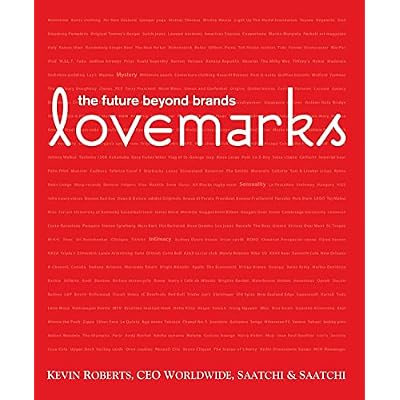
AdAge reports that Kevin Roberts, CEO Saatchi & Saatchi, and his book Lovemarks wooed JC Penny away from DDB Chicago. I had read Lovemarks last winter and thought it was OK, but reread it after I saw the AdAge piece. If that’s worth $430 million, I can start highlighting ideas on my blog that should be worth a few million a pop.
I stand by my “ok” assessment on my first read. The book is interesting, more so for its presentation and graphics than the content. The premise is that emotional connections with customers are what make a relationship between customer and product/service. No big news there, emotional connections are important. Roberts argues that love is the top emotion and claims that the future beyond brands is lovemarks. I’m still a bit befuddled by the future beyond brands, but what’s a book subtitle if not provocative.
Roberts seems to treat the concept of a brand more as a commodity. I think he’s wrong in doing that. I concede that many marketing people try formulaic approaches and pseudo-science which treats consumers more like sheep than humans. Hello Dolly! However, lovemark is really just a strong brand or symbolic identity.
I too try to stay away from the term brands at times, saying that what a person or organization is striving for is a unique symbolic identity. While I agree that emotion is critical in winning the hearts, then the minds (it’s easier to find reason afterwards), it’s more than emotion when it comes to a winning symbolic identity. Unique symbolic identities address human meaning, motive, identity, and emotion. As I mentioned in my critique of Primal Branding, emotion is necessary but not sufficient in developing and grounding a unique identity.
Roberts talks about love, or lovemarks, being comprised of mystery, sensuality, and intimacy. This is where I think Roberts provides strong insight into human connections to brands, lovemarks, or symbolic identities. When he talks about mystery, he’s referring to great stories, myths, dreams, and icons. When he talks about sensuality, he’s referring to the senses – sound, sight, smell, touch, and taste. When it comes to intimacy, Roberts, says that’s “commitment, empathy, passion.” These are important concepts for marketers to consider as they fight the evils of commoditization.
In the cocktail version of the lovemarks story, presented as a photo of cocktail napkin, Roberts shows that at heart he’s really a social scientist as he presents a two-by-two matrix, with one axis as love (low and high) and the other axis as respect (again high or low). In the desired quadrant of high respect and high love, you have a lovemark, the exact opposite of a commodity. Again, I think that lovemark is synonymous with a winning brand or symbolic identity. Interestingly enough, Roberts has fads as low respect, high love. I agree with that assessment, but wished he would have dug a little deeper into the shelf life of fads, or all symbol systems and identities. They will all expire. I’m not sure if Mr. Roberts sees that with lovemarks.
In addition to a discussion of the shelf life of an idea or lovemark, I would have liked for Roberts to separate awareness from advocacy. I see so many marketers talk about awareness and buzz as if it’s all good. It is not. You need awareness, but awareness alone does not constitute success.
You can read more on the lovemarks site.
Subscribe to:
Posts (Atom)