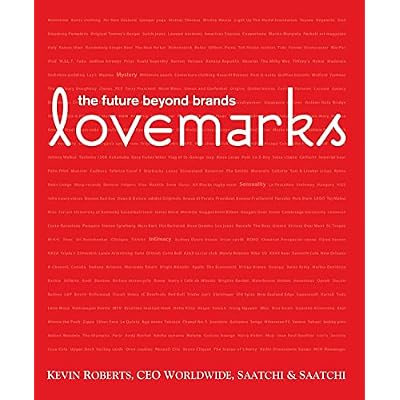
AdAge reports that Kevin Roberts, CEO Saatchi & Saatchi, and his book Lovemarks wooed JC Penny away from DDB Chicago. I had read Lovemarks last winter and thought it was OK, but reread it after I saw the AdAge piece. If that’s worth $430 million, I can start highlighting ideas on my blog that should be worth a few million a pop.
I stand by my “ok” assessment on my first read. The book is interesting, more so for its presentation and graphics than the content. The premise is that emotional connections with customers are what make a relationship between customer and product/service. No big news there, emotional connections are important. Roberts argues that love is the top emotion and claims that the future beyond brands is lovemarks. I’m still a bit befuddled by the future beyond brands, but what’s a book subtitle if not provocative.
Roberts seems to treat the concept of a brand more as a commodity. I think he’s wrong in doing that. I concede that many marketing people try formulaic approaches and pseudo-science which treats consumers more like sheep than humans. Hello Dolly! However, lovemark is really just a strong brand or symbolic identity.
I too try to stay away from the term brands at times, saying that what a person or organization is striving for is a unique symbolic identity. While I agree that emotion is critical in winning the hearts, then the minds (it’s easier to find reason afterwards), it’s more than emotion when it comes to a winning symbolic identity. Unique symbolic identities address human meaning, motive, identity, and emotion. As I mentioned in my critique of Primal Branding, emotion is necessary but not sufficient in developing and grounding a unique identity.
Roberts talks about love, or lovemarks, being comprised of mystery, sensuality, and intimacy. This is where I think Roberts provides strong insight into human connections to brands, lovemarks, or symbolic identities. When he talks about mystery, he’s referring to great stories, myths, dreams, and icons. When he talks about sensuality, he’s referring to the senses – sound, sight, smell, touch, and taste. When it comes to intimacy, Roberts, says that’s “commitment, empathy, passion.” These are important concepts for marketers to consider as they fight the evils of commoditization.
In the cocktail version of the lovemarks story, presented as a photo of cocktail napkin, Roberts shows that at heart he’s really a social scientist as he presents a two-by-two matrix, with one axis as love (low and high) and the other axis as respect (again high or low). In the desired quadrant of high respect and high love, you have a lovemark, the exact opposite of a commodity. Again, I think that lovemark is synonymous with a winning brand or symbolic identity. Interestingly enough, Roberts has fads as low respect, high love. I agree with that assessment, but wished he would have dug a little deeper into the shelf life of fads, or all symbol systems and identities. They will all expire. I’m not sure if Mr. Roberts sees that with lovemarks.
In addition to a discussion of the shelf life of an idea or lovemark, I would have liked for Roberts to separate awareness from advocacy. I see so many marketers talk about awareness and buzz as if it’s all good. It is not. You need awareness, but awareness alone does not constitute success.
You can read more on the lovemarks site.
No comments:
Post a Comment